
· Buying Guides · 22 min read
The Best Rain Gauge, and Where to Put It
The gauge you buy matters less than where you put it. Our picks for every use, plus the placement rule that makes any gauge's reading trustworthy.
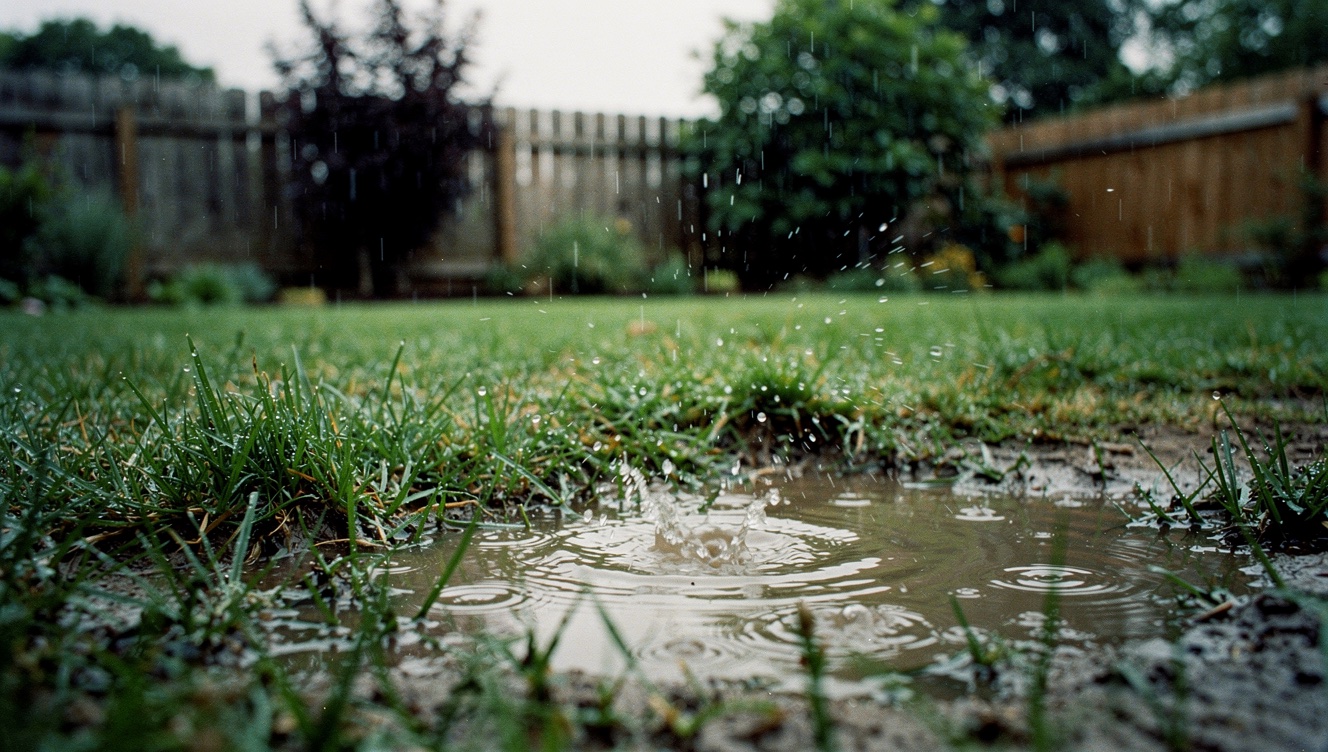
Where you put a rain gauge changes its reading more than which gauge you bought. A $5 plastic tube standing in the open will out-measure a $90 precision gauge mounted against the side of a house, storm after storm. This guide covers both halves of the decision: which gauge fits the way you’ll actually read it, and where to mount it so the number it gives you is true.
We care about rainfall enough that we made an app for tracking it, Rain Tally, which keeps a running record of what falls at your own gauge. We don’t sell rain gauges, and there are no affiliate links on this page, so we have no stake in which one you buy. The picks below are the ones we’d put in our own yard. One of them already is.
We sorted the picks by how you’ll use the gauge, not by price. We checked what each one costs and whether it’s in stock, as of May 2026, because more of them are backordered than you’d expect. And we cover where to put it, since that decides whether the number is any good.
Our picks at a glance
- Best for most people: Headwind EZRead Jumbo, about $20. A 26-inch analog gauge you can read from across the yard.
- Best on a budget: AcuRite 00850 Magnifying, under $10. A magnifying tube you can read across a small yard.
- Best wireless: AcuRite 02446M, $35 to $40. Rainfall on an indoor display, no trip outside.
- Best for a remote property: Edwards Tru-Chek RG100, $22 to $24. No power, no batteries, nothing to fail between visits.
- Most accurate: Climalytic TROPO, $89.99. One of only two gauges the national volunteer rain-observer network (CoCoRaHS) approves, engineered to under 1% error.
The best rain gauge for most people: Headwind EZRead Jumbo
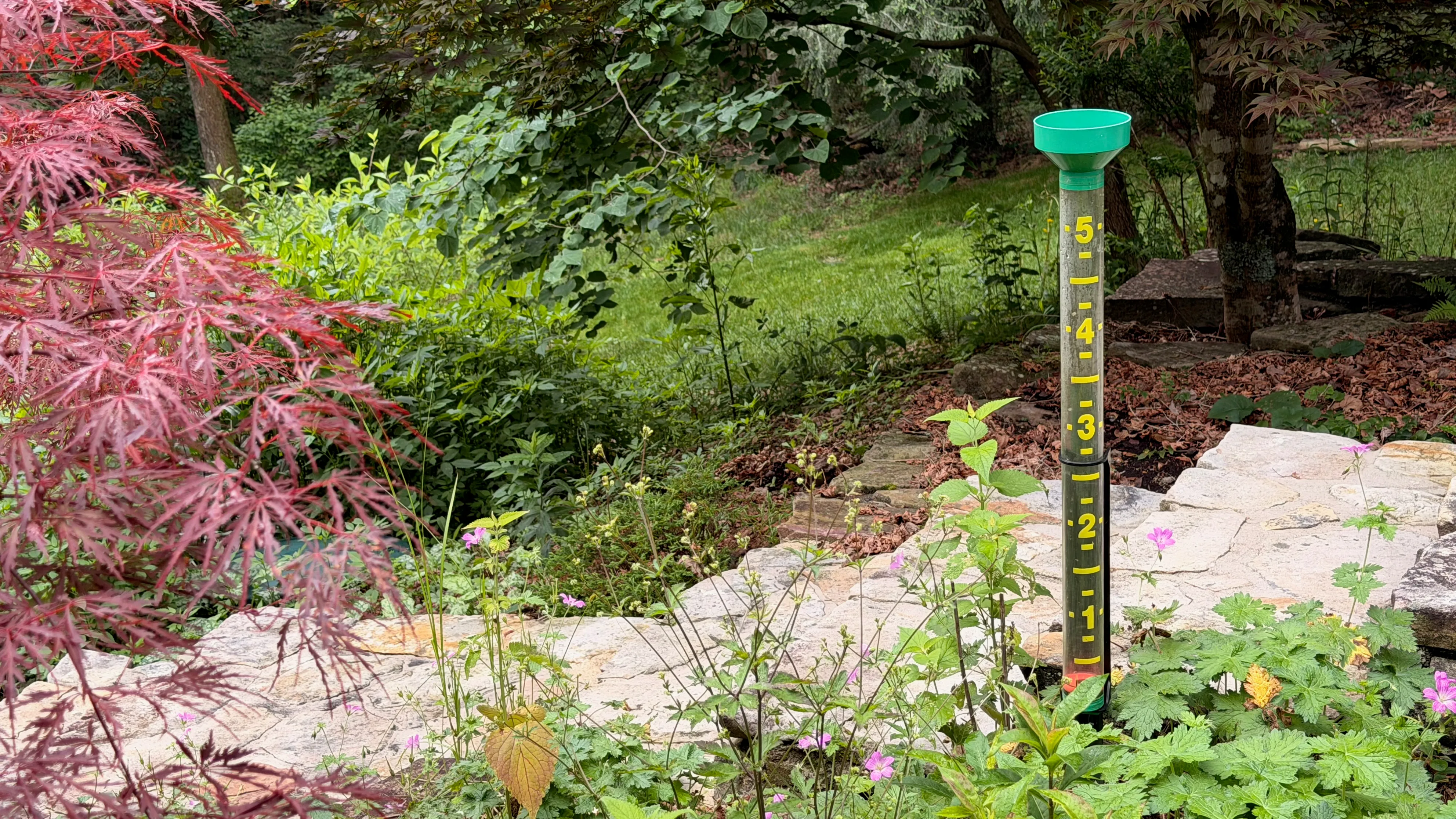
If you just want to know what fell in the yard and read it without effort, get the Headwind EZRead Jumbo. It’s a 26-inch plastic tube with a float that rises as rain collects, and the whole point of it is that you can read the number from fifty feet away.
Why we like it
The size is the feature. At 26 inches tall with large numbers and a float sitting right at the water line, the EZRead is built to be read from across the yard or through a kitchen window, so checking it most mornings doesn’t mean walking out to it. It’s made in the USA, costs about $20, and is easy to find on Amazon or at Walmart. For a gauge you’ll glance at every day, that combination is hard to beat. Pictured above is the one in our own yard.
Who this is for
This is the gauge for the homeowner or gardener who wants the morning’s number on the way past, not someone filing readings to a weather network. If you water a lawn or a garden and mostly want to know whether last night’s rain was enough, the EZRead tells you from a distance and asks nothing else of you. The quarter-inch markings won’t satisfy anyone who needs hundredths of an inch. If that’s you, skip ahead to the precision gauges below.
Flaws but not dealbreakers
The plastic is thin. One owner on DoMyOwn wished it were “a thick plastic, not the bendable paper thin plastic that it is.” The painted-on scale can fade after years in the sun, and the tube grows brittle with age. Clark Tate, the lead tester at TechGearLab, owned one as a child and reported that “the letters eventually faded, and the funnel cracked.” And like every tube gauge in this guide, it isn’t freeze-proof. Water left to freeze in the tube can crack it, most of all when the tube is full and the ice has nowhere to expand, so empty it and bring the float inside before a hard freeze.
None of that disqualifies it for daily yard reading, which is the job. It’s a gauge you replace every few years, not an heirloom you pass down.
If $20 is more than you want to spend for a number you check in passing, the next pick costs about a fifth as much.
The best budget rain gauge: AcuRite 00850 Magnifying
If you just want a number and want to spend almost nothing, the AcuRite 00850 does the job for under ten dollars. We’ve seen it for $4.99 at Farm & Fleet.
Why we like it
A magnifying lens molded into the front of the tube enlarges the water level by about a third, so the white-on-blue numbers read clearly across a small yard even though the gauge stands only five inches tall. It stakes into the ground or screws to a fence post, holds five inches of rain, and costs less than a sandwich. For a first gauge, or a cheap second one at the far end of the yard, that covers it.
Who this is for
This is the gauge for casual users, renters who’d rather not sink money into a yard they’ll leave, and anyone who wants an inexpensive second gauge to check against a main one. If you’ll be reading it from more than about twenty-five feet, step up to the EZRead Jumbo instead. The 00850 reads well across a small yard, not a big one.
Flaws but not dealbreakers
The resolution is a quarter inch, so this is a gauge for “about half an inch,” not “0.43 inches.” The acrylic is light and can yellow over a few seasons, and like the other tubes here it can crack if it freezes full. One thing to know before you shop: AcuRite’s own site lists the 00850 as backordered as of May 2026, so buy it at Farm & Fleet, Walmart, or Amazon, where it’s in stock and often runs cheaper than list price anyway.
Both the EZRead and the 00850 make you walk outside to read them. If that’s the part you’d skip, the next gauge brings the number indoors.
The best wireless rain gauge: AcuRite 02446M
To read rainfall without walking outside, the AcuRite 02446M is the one most people should buy, as long as you go in knowing what wireless costs you in lifespan.
Why we like it
Instead of a tube you read by eye, the 02446M uses a self-emptying collector called a tipping bucket: a small seesaw inside the outdoor sensor tips and empties each time it catches another hundredth of an inch, and a radio sends every tip to an indoor display up to about 100 feet away. The display keeps running totals for the day, the past week, and longer, and it can sound an alarm when rain is falling fast. Setup takes a few minutes. At $35 to $40 it’s the best-selling wireless gauge for a reason: the number sits on a screen in your kitchen instead of out in the yard.
Who this is for
This is the gauge for someone who wants rainfall on a screen indoors and treats replacing the sensor every couple of years as the price of not going outside for it. If you check rain often, want a fast-rain alarm, or know you won’t keep up a habit that means walking out to a tube, the 02446M fits.
Flaws but not dealbreakers
A wireless gauge is a different kind of purchase than a plastic tube. Buy one expecting to replace it every couple of years, not to keep it for a decade the way you might one of the tube gauges above. The tipping mechanism wears, and AcuRite’s sensors have a well-documented habit of quitting around the 18-month mark. One Amazon reviewer summed up the pattern: “I loved this rain gauge… after 18 months it simply stopped working. I checked all the batteries and they are still strong.” Insects are the other recurring complaint, because the collector sits open to the weather. One owner found the gauge stuck at zero after a storm and discovered “a big spider in there that had run webs across the measuring spoons.” It also can’t be left out below freezing; water in the mechanism cracks it, which makes any wireless gauge three-season hardware in a cold climate.
There’s an accuracy cost too. A tipping bucket undercounts by its nature, most of all in light rain and in the first minutes of a storm, before the seesaw tips the first time. That doesn’t rule the 02446M out for everyday backyard use; it just means the convenience comes with a number a little softer than a well-placed tube’s.
An alternative for a longer-lived record: Ecowitt WH5360B
If you want a gauge that lasts longer and keeps a multi-year record, look at the Ecowitt WH5360B, about $60. Its sensor is sealed against the bugs that jam cheaper buckets, the console stores 730 days of history, and the radio reaches roughly 300 feet. One owner who had lost “several high-priced, big name weather stations” to ant infestations bought the Ecowitt because “the unit was indeed sealed… with no entrances for small pests.”
One catch goes unmentioned in most buying guides. The WH5360B console by itself does not connect to Wi-Fi, an app, or any website. To get readings onto your phone, you have to buy a separate Ecowitt GW1100 gateway for about $25 and pair the sensor to it. Without the gateway, your rainfall stays on the console and nowhere else.
And if what you really want is one box that joins your Wi-Fi with no hub and no full weather station attached, there isn’t a good one right now. The closest, La Crosse’s 724-1415BL, has been retired by the manufacturer, though stores are still clearing leftover stock. Skip it: there’s no telling how long the app and service behind a discontinued unit keep working. La Crosse’s current standalone gauge is the 724-1409V2.
Wireless gauges assume power and a signal that reaches back to the house. Plenty of useful spots have neither.
The best rain gauge for a remote property: Edwards Tru-Chek RG100
For a food plot, a back pasture, or any spot with no power and no Wi-Fi, the Edwards Tru-Chek RG100 is the right gauge, precisely because there’s nothing in it to fail.
Why we like it
The Tru-Chek is a single piece of USA-made plastic shaped like a wedge, wide at the top and narrow at the bottom. Because it narrows, even a little rain rises high enough on the scale to read down to a hundredth of an inch, no magnifier needed. It mounts to a 4x4 corner post and has no batteries, no radio, and no sensor. Nothing in it can stop working between visits, which is the entire point at a place you reach twice a month. It’s been made the same way since the 1980s, and agricultural extension agents in citrus and row-crop country have pointed growers to it for about as long.
Who this is for
This is the gauge for the hunter managing food plots, the grower with fields off any road, and anyone tracking rain at a place they don’t live. If the patch you care about is forty acres you visit on weekends, a wireless gauge has nothing to talk to, and a fragile tube means a long drive to re-read a cracked one. The Tru-Chek sits there and holds the number until you come back. Pair it with a cheap logbook in the truck and you have a running record without a single battery.
Flaws but not dealbreakers
You have to walk right up to read it. It’s clear plastic with a fine scale, so there’s no checking it from across the field the way you would the tall EZRead; you read it standing over it. For anyone driving out to do the rounds, that’s no inconvenience, but it’s worth knowing the Tru-Chek is a get-close gauge. The plastic also clouds over the years. One grower who had used Tru-Cheks for years said they “cloud up after awhile and you can’t read the amount,” though most owners read them fine well past that point and simply swap in a fresh one when it gets bad. The wedge is coarser than a precision tube if you’re reporting to a weather network, but network-grade accuracy isn’t what a food plot needs. One honest limit on this pick: the remote-property category is thin on published owner reviews, so this recommendation leans on the gauge’s mechanical simplicity more than on a deep pile of field reports. That simplicity is exactly why we trust it where nothing else gets serviced.
If what you want instead is the most accurate number a backyard gauge can give, two gauges meet the scientific standard.
The most accurate rain gauge: Climalytic TROPO
If you want the most accurate reading a consumer gauge can give, buy the Climalytic TROPO. It costs $89.99 direct from the maker, or around $66 on Amazon, and it is one of only two 4-inch gauges approved by CoCoRaHS, the volunteer rain-observer network whose daily readings feed into National Weather Service data.
Why we like it
The TROPO is a 4-inch gauge, meaning the funnel that catches the rain is four inches across, the size CoCoRaHS (the Community Collaborative Rain, Hail and Snow Network) and the National Weather Service treat as standard. The network has approved exactly two of these gauges: the long-running Stratus and, since 2023, the TROPO. The TROPO is the more precise of the pair, engineered by its maker to under 1% error against the National Weather Service’s reference 8-inch gauge, where the Stratus reads about 2.5% high. Rain collects in a narrow inner tube marked in hundredths of an inch, which makes it easy to read closely, then overflows into a 13.5-inch outer cylinder, so a heavy storm won’t top it out before you get to it.
Who this is for
This is the gauge for the serious backyard observer, the accuracy-minded gardener, and anyone who reports readings to a weather network. It is more gauge than a casual yard-watcher needs, and exactly enough for someone who wants a reading good to a hundredth of an inch.
An alternative if $90 is too much: the Stratus
If $90 is more than you want to spend, the Stratus Precision Rain Gauge at about $40 is the budget alternative, and it gives up nothing on legitimacy. It has been the CoCoRaHS standard for 25 years and meets the network’s requirements in full. It reads about 2.5% high rather than under 1%, a gap that matters if you’re contributing to a research dataset and barely at all if you aren’t. Just buy the genuine article from Weathershack, Tractor Supply, or Darter Products direct, not an Amazon lookalike.
Flaws but not dealbreakers
At $90, the TROPO costs several times what any other pick here does, and only a minority of backyard observers need this much accuracy. Like every tube in this guide, it has to be drained before a hard freeze so trapped water can’t crack it. And the accuracy claims deserve a caveat: the under-1% figure for the TROPO comes from the maker’s own testing, which isn’t fully independent. The Stratus’s 2.5% figure has the stronger backing, from a decade-long comparison by the Colorado Climate Center; the TROPO is newer, and its independent track record is shorter.
Those five are the gauges we’d buy. A few popular ones we wouldn’t, and one whole category is a different purchase than the one you came here to make.
What to skip
Knockoff “Stratus” gauges. The genuine Stratus is made by Productive Alternatives, a Minnesota non-profit. The 4-inch gauges sold on Amazon and Home Depot under invented brand names like TAMIDN, LIGHT JAY, FUAUFAS, and Emphira are not the same gauge, and CoCoRaHS’s field testing found they under-measure rain because the inner tube is mis-calibrated. The tell is the brand: a real Stratus says Productive Alternatives and ships from Weathershack, Tractor Supply, or Darter Products. If the seller’s brand name looks like a randomly generated password, skip it.
Decorative and novelty gauges. The copper stakes, the glass globes, the frog statues, the “World’s Coolest Rain Gauge,” all of it is yard art with a tube attached. Resolution is a quarter inch at best, the scales fade, and none of them publishes an accuracy figure. Buy one because you like how it looks among the tomatoes, not because you want to know how much it rained.
When a weather station is the answer, and when it isn’t
If you want wind, temperature, humidity, and rain on one dashboard, a home weather station from Tempest, Ambient, or Davis is a reasonable thing to buy. But it’s a $190 to $1,600 purchase, and rain is only one of its sensors. Buying a whole station just to measure rainfall means paying for instruments you didn’t want, and the rain sensor inside it is the same kind of tipping bucket that undercounts light rain and can’t be left out to freeze. Most “best rain gauge” lists fold weather stations into the rankings, which nudges someone after a $40 gauge toward a $300 station. If a weather station is what you want, buy one deliberately. If you only want to know how much rain fell, the gauges above do that job better for less.
Whichever gauge you land on, the brand on it matters less than the decision you make next: where you put it.
Where to put your rain gauge
This is the decision that matters most for accuracy. A gauge should sit twice as far from any object as that object is tall. A 20-foot tree means it belongs at least 40 feet away.
Why placement beats the brand
Due to the wind, a rain gauge catches less than truly falls. Air speeds up as it lifts over the mouth of the gauge and pushes raindrops past the opening, so some of the rain never lands inside. This shortfall is called undercatch. A 1974 study by Larson and Peck in Water Resources Research found an unshielded gauge loses roughly 1% to 2.2% of its catch for every mile per hour of wind at the opening; a steady 10-mph wind takes 10% to 22% off the top. A 2025 review in Weather put typical tipping-bucket undercatch at 5% to 46%, driven mostly by exposure. No $40 gap between two gauges comes anywhere near those numbers. Where you place the gauge makes much more of a difference.
Where not to put it
A few common spots wreck a reading:
- Near the side of a house, where roof runoff and splashback find the gauge and the wall churns the wind right where it sits.
- On a deck or balcony railing, where splashback off the rail finds the gauge. NOAA’s record-vetting committee has rejected proposed state rainfall records because a gauge “was placed too close to a sloping roof or a fencepost and therefore may have collected splashes or drips as well as rain.”
- Under a tree, where the canopy holds rain back and then drops fat, late drips long after the storm has passed.
- On a rooftop, where wind runs stronger than at ground level and carries even more rain past the opening. William Heberden measured this in 1769: a gauge on a low rooftop caught about 80% as much as one in the garden below, and a gauge atop Westminster Abbey caught barely half.
How high, and what to mount it on
With the spot chosen, the next questions are how high to set the gauge and what to put it on. CoCoRaHS calls for it 2 to 5 feet off the ground and fixed to the side of a post rather than the top. Mount it flat on top of the post instead, and rain hits the post and splashes up into the gauge. For the same reason, give the post a rounded or slanted top. Keep it level, too: a gauge that leans even a few degrees changes how much of its opening faces straight up, which throws off the catch. How high within the 2-to-5-foot range depends on how open the spot is. Climalytic, which makes the TROPO, recommends about 2 to 3 feet in an open area and 5 to 6 feet in a developed yard with fences and walls, to keep the opening above the splash and the churning air those structures stir up near the ground.
Winter
Don’t let water freeze inside the gauge, or it will crack the tube. In cold country, drain the gauge or pull the inner tube before a hard freeze. A wireless gauge can’t do any of this, which is why it’s three-season hardware anywhere nights drop below freezing.
Don’t chase tenths
Even a perfectly placed gauge under-reports the rain that reached the ground around it, by about 3% to 5% on an ordinary day and more when it’s windy. The gauge disturbs the air above its own opening, and no backyard design fully fixes that without burying the gauge at ground level. So don’t agonize over a few hundredths of an inch between two gauges on the same property. The realistic margin for any above-ground gauge is about a tenth of an inch on a stormy day. What matters more than squeezing out accuracy is consistency: the same gauge, in the same spot, read at the same time each day. That is the number you can actually compare against itself over a season.
Get the gauge right and the spot right, and you have a number you can trust.
Keeping a record of what falls
A rain gauge tells you how much fell today. It has no memory of yesterday, last week, or last June, and that memory is what turns a reading into something you can act on. Has the yard had its inch this week? Is the season running drier than last year? Did the back field catch the same storm as the front? None of it lives in a single number. Keep the readings and the answers appear, as a running weekly total, this year traced against past years, and each location held as its own history, including the ones with no street address.
The app we built, Rain Tally, keeps that record, and two things it does are worth knowing here. When you look at any weather app during a storm, the rainfall amount you are seeing is the forecast. After the storm, weather service employees check their own rain gauges and update their systems. Rain Tally keeps checking after the storm and updates your rainfall total after the final numbers come in. And when your gauge and the weather service disagree, your gauge wins: log what you caught in your own gauge in the app, and every chart in the app updates using your value.
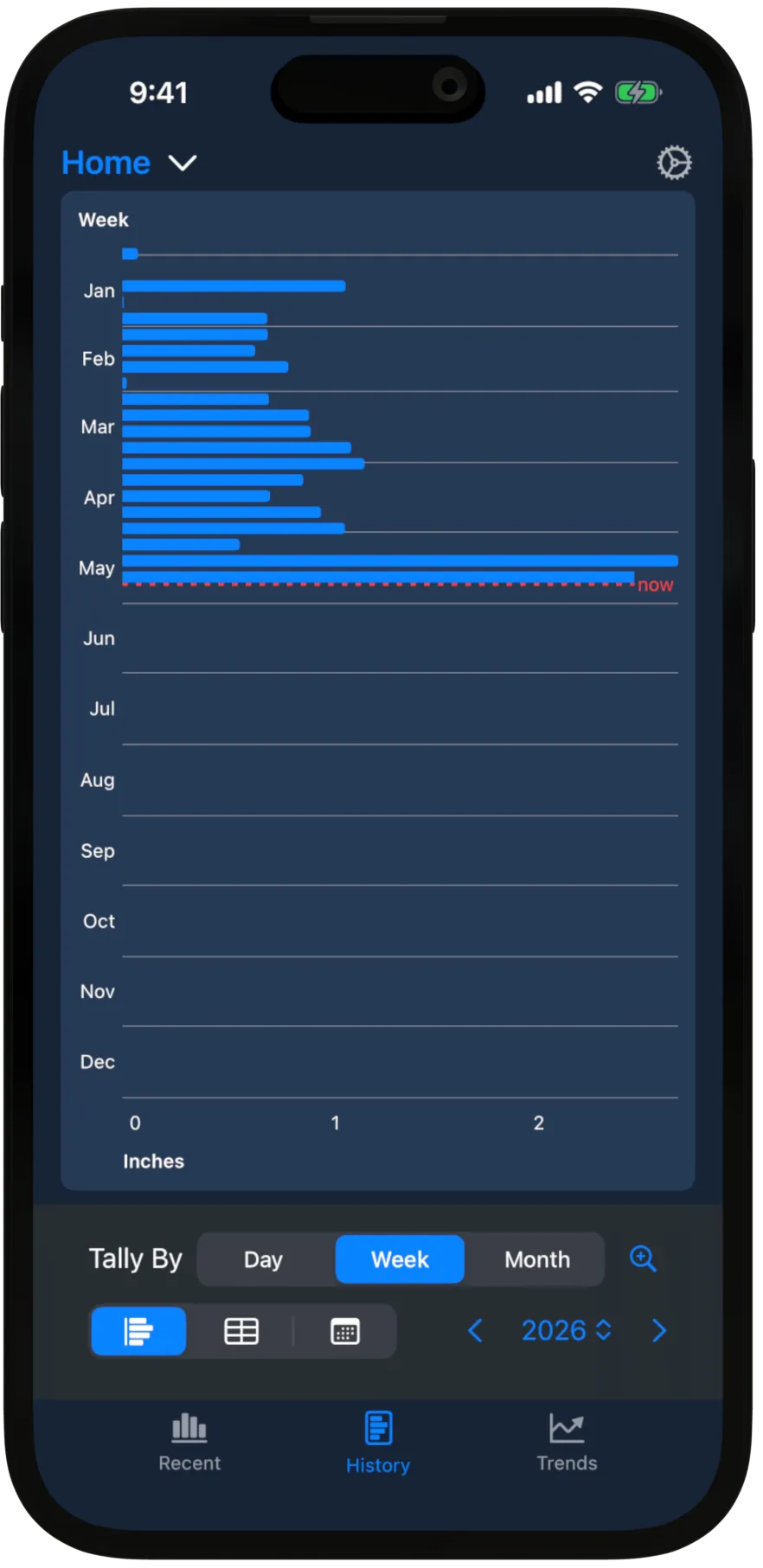
Rain Tally also covers the days you don’t. Miss a reading, or let the gauge overfill before you get to it, and the app fills the gap with the weather service’s number so the record stays whole. The gauge is the accurate instrument; the app is the memory that doesn’t depend on you never missing a day.
If that’s where you’re headed next, we compared the apps that track rainfall and where Rain Tally lands among them. For the app built to log the gauge you just bought, there’s the best rain gauge app; if you’re weighing skipping the hardware altogether, that’s a virtual rain gauge.
Frequently asked
Where should I put my rain gauge?
Put it twice as far from any object as that object is tall, so a 20-foot tree means at least 40 feet of distance. Mount it 2 to 5 feet off the ground, on the side of a post rather than the top, in the most open spot you have. Where you place it changes the reading more than which gauge you bought.
What is the most accurate rain gauge?
The most accurate consumer gauges are the 4-inch tube gauges CoCoRaHS approves, the Climalytic TROPO and the Stratus, both of which measure to a hundredth of an inch against the National Weather Service standard. But placement affects accuracy more than the model does, so site any gauge well before paying up for precision.
Are wireless rain gauges accurate?
Within limits. Wireless tipping-bucket gauges like the AcuRite 02446M undercount light rain and the start of a storm, before the first tip registers. They also tend to fail around 18 months and can’t be left out below freezing. For reading rainfall indoors they’re fine; for precision, a tube gauge beats them.
Stratus vs. AcuRite: which should I buy?
They do different jobs. The Stratus, or the TROPO, is a manual tube gauge built for accuracy and for reporting to a weather network. The AcuRite is a wireless gauge built for reading rainfall indoors without walking outside. Buy the Stratus for an accurate record, the AcuRite for convenience. Plenty of people keep both.
Do I need to bring my rain gauge in for winter?
If water can freeze inside it, yes. A tube gauge will crack if it freezes full, so drain it or pull the inner tube before a hard freeze. Wireless gauges can’t be left out below freezing at all. In a cold climate, treat any rain gauge as three-season equipment.
- best rain gauge
- rain gauge
- rain gauge placement
- wireless rain gauge
- rainfall