
· Comparisons · 13 min read
Rain Tally vs. Bushel Farm: Just the Rainfall, Not the Whole Farm Software
The iPhone app for per-field rainfall: totals, history, and pin-drop fields, at a fraction of a Bushel Farm subscription. $19.99 a year against $199.
FarmLogs tracked per-field rainfall for free until February 2019. The feature lives inside Bushel Farm now, and the cheapest plan that includes rain history costs $199 a year. Bushel’s entry-level $75 “Rainfall” tier shows recent rainfall only; rain history and the monthly rainfall report start at the $199 Lite tier.
Whether you used FarmLogs and lost it, or you’re pricing per-field rainfall for the first time, the cost is the same. If rainfall is the only part of Bushel Farm you use, Rain Tally tracks the same per-field totals on iPhone, with deeper history and your own gauge readings, for $19.99 a year. You drop a pin on each field and get its full history and year-to-date total, without paying $199 for software you won’t otherwise use.
Rain Tally Pros
- Drop a pin on each field, no street address needed
- Per-field history and year-to-date totals
- Log your own rain-gauge reading and every total recomputes using it
- Water-year totals (October through September)
- Plus is $19.99 a year for 10 fields; Pro is $49.99 for 50
Rain Tally Cons
- iPhone and iPad only
- No growing degree days or heat units
- Forecast horizon stops at 3 days
Bushel Farm Pros
- Field mapping, soil maps, scouting, grain marketing, and farm finance in one platform
- Rain history included on the $199 Lite tier and up
- Runs on Android and iOS
Bushel Farm Cons
- Cheapest tier with rain history is $199 a year
- The $75 Rainfall tier shows recent rainfall only, no history
- Built around grain marketing and records, not a quick per-field rain check
At a glance
Side by side, the three tools differ most on what rainfall costs and how far back you can look.
| Rain Tally | Bushel Farm | Climate FieldView | |
|---|---|---|---|
| Per-field rainfall | Yes | Yes | Yes |
| Entry price with rain history | $19.99/yr | $199/yr | $649/yr |
| Monthly plan | $1.99/mo | Annual only | Annual only |
| Look back at past rainfall | Full daily history | Lite tier and up | Season-to-date; limited day-by-day |
| Drop a pin on a field | Yes | Yes | Yes |
| What it is | Rainfall app | Farm-management platform | Farm-management platform |
What happened to free rainfall tracking
FarmLogs was free, and a lot of hunters and growers used it to track rainfall on their fields. In early February 2019, FarmLogs started charging. Forum threads about finding a replacement appeared that same month: an AgTalk thread posted on February 13, 2019, and a HayTalk thread titled “FarmLogs no longer free.” Those threads quote a price of $99 a month. That was the 2019 price for the activities and marketing plan; today’s price is lower and set up differently. The price has come down since then, but rainfall is still something you pay for.
FarmLogs is still around under a different name. Bushel bought it in 2021 and renamed it Bushel Farm in 2023. In May 2026, the iPhone app was renamed again, to Bushel. On Android it is still called Bushel Farm. It is the same app either way, so if you go looking for it, that is the name to expect.
Bushel sells rainfall on more than one plan. The $75 plan shows recent rainfall, field maps, and soil maps, but not past rainfall. To see how much rain fell on a field last month, you need the $199 Lite plan, which adds rain history and a monthly rainfall report. So the lowest price for rainfall with history is $199 a year. David Rogers said as much in a Google Play review in March 2023: “I really liked the farmlogs app. I used it to track rainfall out at a recreation property and feel it was fairly accurate. … I’d be willing to pay $3-5 a month for rainfall data but $20 a month is ridiculous. … It was fun while it lasted.”
The forum threads point to a few other options. Growers already running a full platform usually name Climate FieldView. DocHolladay wrote, “FieldView is what I use. It’s been correct every time I have checked rain gauges.” For a free option, some point to the National Weather Service site; Drycreek asked, “Have any of you tried water.weather.gov?” One hunter, Longleaf, found an app called Pocket Rain Gauge: “Found what I was looking for. Agrible.com. Their app is ‘Pocket Rain Gauge.‘” That app is no longer available. Nutrien, which had bought Agrible, removed it from both app stores in 2026.
Tracking rainfall by field
Rain Tally tracks how much rain has fallen at each of your fields, and how much is coming. That is the whole app. Bushel Farm tracks the same rainfall, but it is one feature inside software built for grain marketing and farm records.
A pin on every field. Fields and food plots don’t have street addresses. In Rain Tally, you drop a pin on the map instead, on a plot, a pasture, or the back corner of a property. Each field is tracked separately, a virtual rain gauge for every pin, no hardware or street address required.
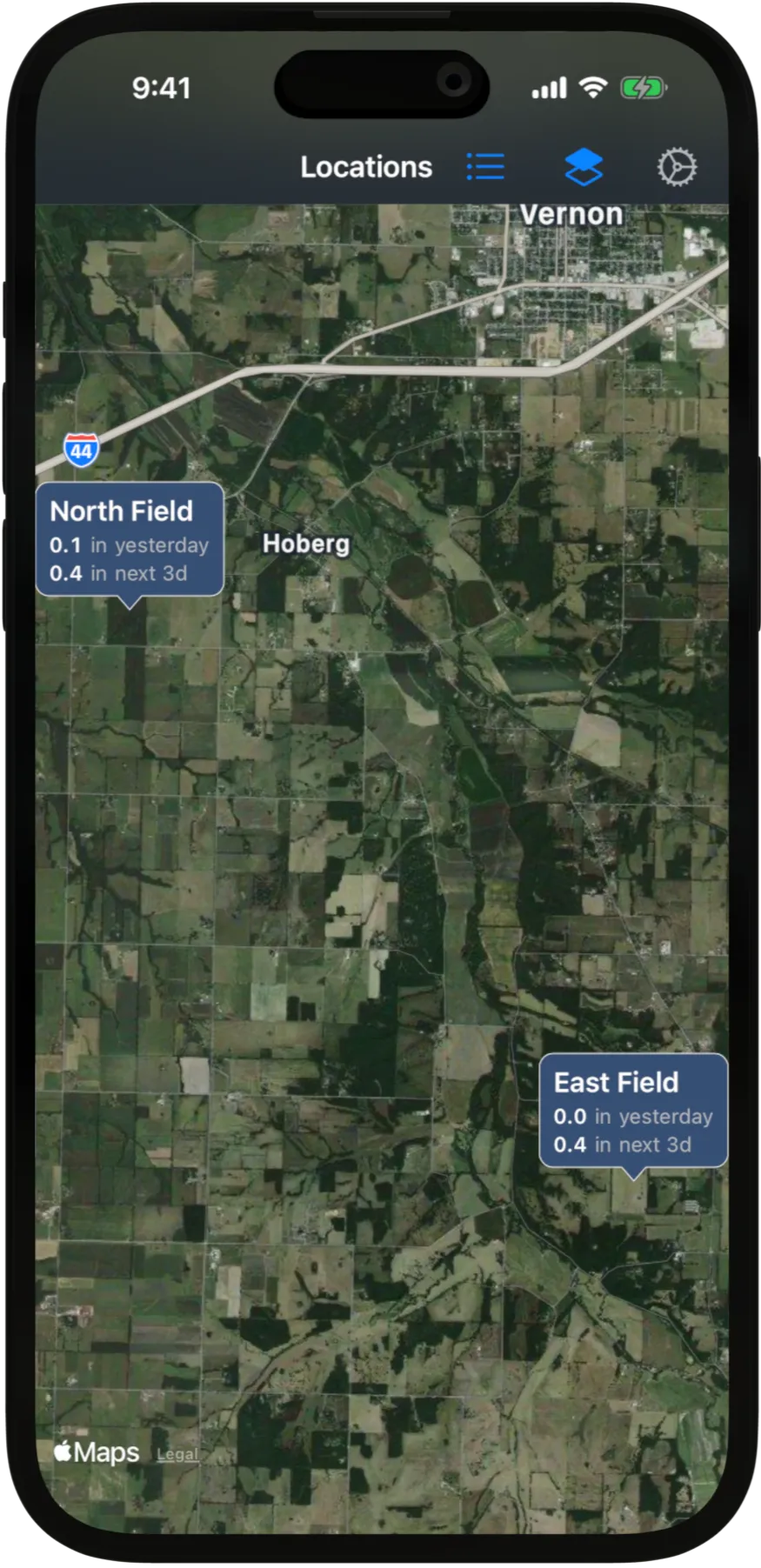
Past rain and the forecast on one screen. The main screen shows the last seven days of rain next to the next three days of forecast, with a weekly target underneath. It is meant to help you time the work: some rain has fallen, more is coming Thursday, so do you plant or irrigate now, or wait? SP Arkansas, an App Store reviewer, wrote in May 2024: “As a Game Keeper and food plot enthusiast, I can say this app will save you money, and a headache. … [the app] is cheap compared to replanting!”
Your own gauge wins. If you keep a rain gauge at a field, you can enter what it read, and the app uses your number in place of the weather service’s. Most days the two are close. On the days they aren’t, the app goes with your gauge.
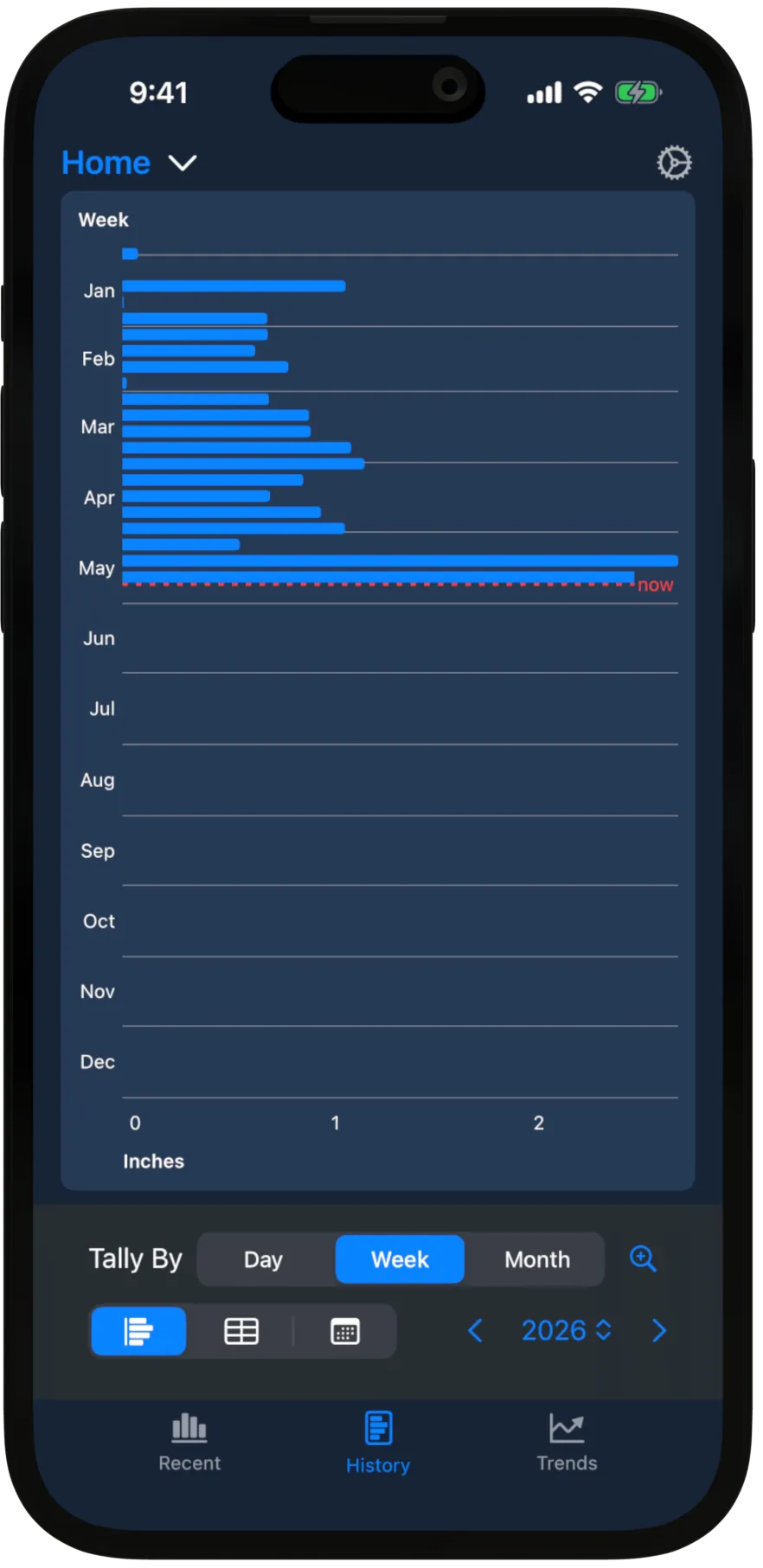
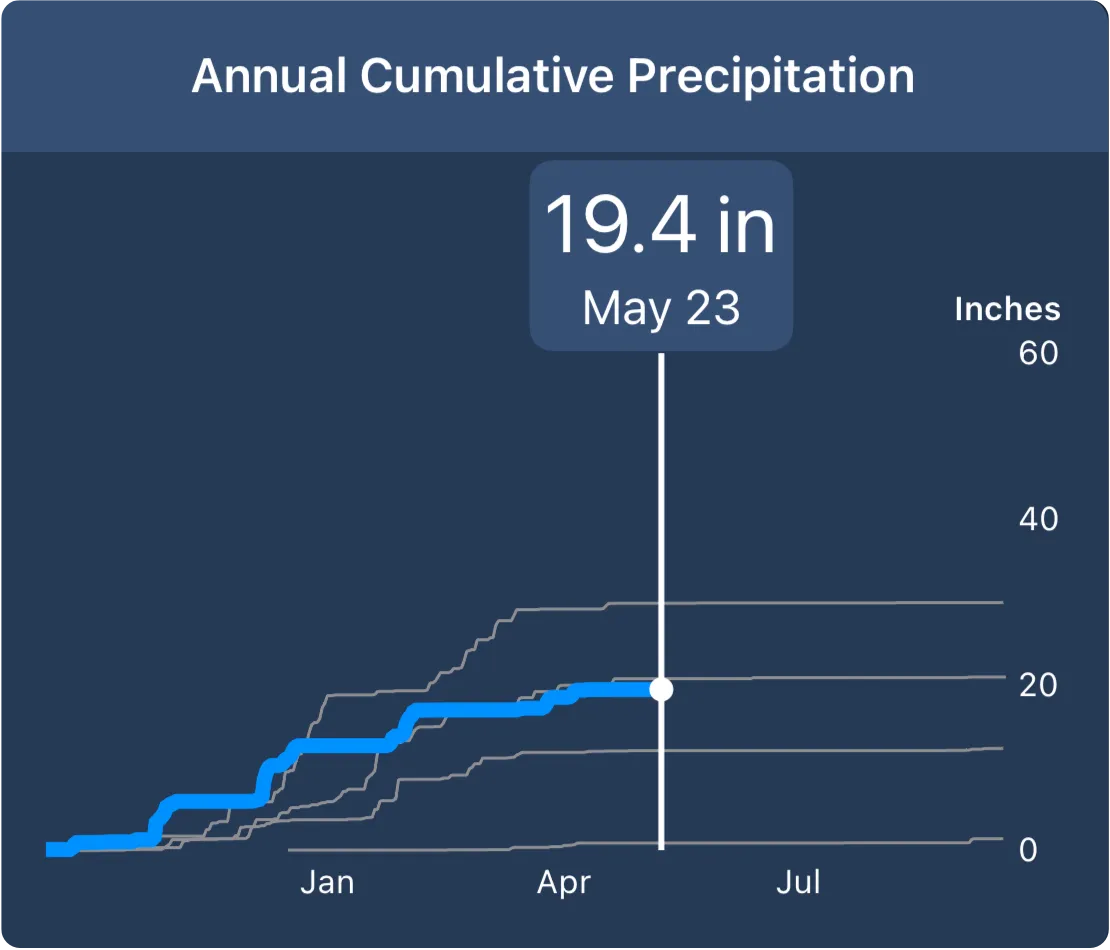
History and year-to-date. You can look back at any year by day, week, or month, as a chart, table, or calendar, and see whether the season is running wet or dry compared with past years. You can also total rainfall by water year, October through September, so a full wet season is one period. This is the look-back FarmLogs users lost, and it is more than Climate FieldView gives you. As pinetag put it on one forum thread: “Climate View will give you the rainfall totals for yesterday, today, and year to date but you can’t look back at historical dates either.”
Pricing
Rain Tally Plus is $19.99 a year, or $1.99 a month, and tracks 10 fields with full history and trends. Pro is $49.99 a year for 50 fields. Both are well below every competing plan that includes rain history. Bushel’s Lite plan is $199 a year. Climate FieldView’s Plus plan starts at $649 a year, with rainfall as one part of it.
One inch of rain on one acre is about 27,154 gallons. Misjudge whether a plot got enough of it, and you can lose a planting to dry ground or to washout and pay to put it in again. Against the cost of replanting, the price of the app is a small line item.
Rain Tally has a free tier, but it is limited for this use. Free covers one field and the recent view: the past seven days and the three-day forecast. History and the year-over-year trends are part of Plus. So if you want to look back across a season, the real starting price is $19.99 a year. The National Weather Service site at water.weather.gov is free if you are willing to look up each field by hand. Bushel does not include rain history on any free plan.
When another tool is the better fit
Rain Tally is not the right pick for everyone. For some readers, one of these is the better choice.
Climate FieldView, if you already run it. Climate FieldView is good at what it does: running a row-crop operation, with seeding, scouting, and yield in one place. If you already use it, your rainfall sits next to the rest of your records, and there is little reason to add a second app. Rain is one part of its Plus plan, which starts at $649 a year. Some users have reported the rainfall readings becoming less accurate after a 2026 update, so it is worth checking against your own gauge. FieldView is the better tool for a grower already on the platform; it is more than someone who only wants rainfall needs to buy.
The National Weather Service, if you will do it by hand. The site at water.weather.gov shows NOAA precipitation data for free, with no app and no subscription. If you are willing to look up each field yourself, and you don’t need the history kept for you, it is a fair free option.
Bushel Farm, if you want the whole platform. If you want grain marketing, contracts, soil maps, and farm finance along with the rain, Bushel does all of that. The $199 to $599 plans are buying a farm-management platform, not just a rain tracker. If that is what you are after, the price fits what you get.
Limitations
Rain Tally is focused on being the best rainfall app on iOS, so a few things fall outside what it does.
iPhone and iPad only. There is no Android app and no web version. On Android, Precip is the better choice for tracking rainfall amounts; it was the Android pick in a roundup of apps for tracking rainfall totals.
No growing degree days or heat units. FarmLogs offered crop-development numbers like heat units, and Bushel and FieldView still do. Rain Tally does not. It tracks rainfall, and that is all.
Snow depth and long-range forecasts. Snow is measured by the water it melts down to, the moisture that reaches the ground, not by depth in inches. The forecast goes out three days, because rainfall amounts further out are not reliable enough to plan on. If you want snow depth or a 10-day outlook, a regular weather app does those.
Per-field rainfall is an estimate. This is true of every app, not just Rain Tally. Rainfall can vary by inches over a mile inside one storm, and no app or weather service can read that from radar alone. As one hunter put it on the Deer Hunter Forum: “If someone is promoting rainfall totals via an app on individual fields they are being dishonest. Farmlogs used Dopplar Radar data obtained from NWS and that’s an average of precipitation over 4 sq km.” Every per-field app, including this one, works from the same public radar and gauge data. That is the case for keeping a gauge at a field: log what it reads, and the app uses your number for that spot instead of the radar estimate.
Verdict
For per-field rainfall on an iPhone, Rain Tally is the pick. It tracks how much rain fell on each field, shows what is coming, keeps the history, and lets your own gauge override the estimate. It costs $19.99 a year, compared to $199 for the cheapest Bushel plan with rain history.
There are trade-offs. It runs only on iPhone and iPad, it does not track heat units, and it counts snow as melted water rather than depth.
If your rainfall already lives inside Climate FieldView and you run the rest of it, stay there. If you want a free option and don’t mind looking up each field one at a time, the National Weather Service site does that. For everyone else who wants per-field rainfall on their phone without paying $199 for software they won’t otherwise use, install Rain Tally.

Free for one field. Plus is $19.99 a year or $1.99 a month for 10 fields, with full history and trends. Pro is $49.99 a year for 50. Requires iPhone or iPad, iOS 17.2+.
Frequently asked
What is the cheapest way to track rainfall by field?
Rain Tally Plus is the cheapest option with history: $19.99 a year for 10 fields, with full records and year-over-year trends. Its free tier covers one field but not history. Bushel’s rainfall plans start at $75 a year for recent rainfall only; the first plan with rain history is $199 a year.
Do I need Bushel Farm just for rainfall?
No. Bushel Farm is farm-management software built around grain marketing and records, with rainfall as one feature. If rainfall is all you want, a rain-only app like Rain Tally tracks it per field for far less: $19.99 a year compared to $199 for the cheapest Bushel plan with history.
Is there a free way to track rainfall by field?
Yes, with limits. The National Weather Service site at water.weather.gov shows free precipitation data, but you look up each field one at a time and nothing is saved for you. Rain Tally’s free tier covers one field and recent rainfall, though history and trends require Plus.
Can I track fields with no street address?
Yes. In Rain Tally you drop a pin on the map for each field, plot, or pasture, with no address needed. Each one keeps its own past rainfall, forecast, and year-to-date total. Bushel and Climate FieldView also support map-based fields.
- bushel farm alternative
- farmlogs alternative
- per-field rainfall
- rainfall app
- food plot rain tracker